
The Hidden Forest: Kelp, Folklore, and Climate Action Along the Firth of Forth
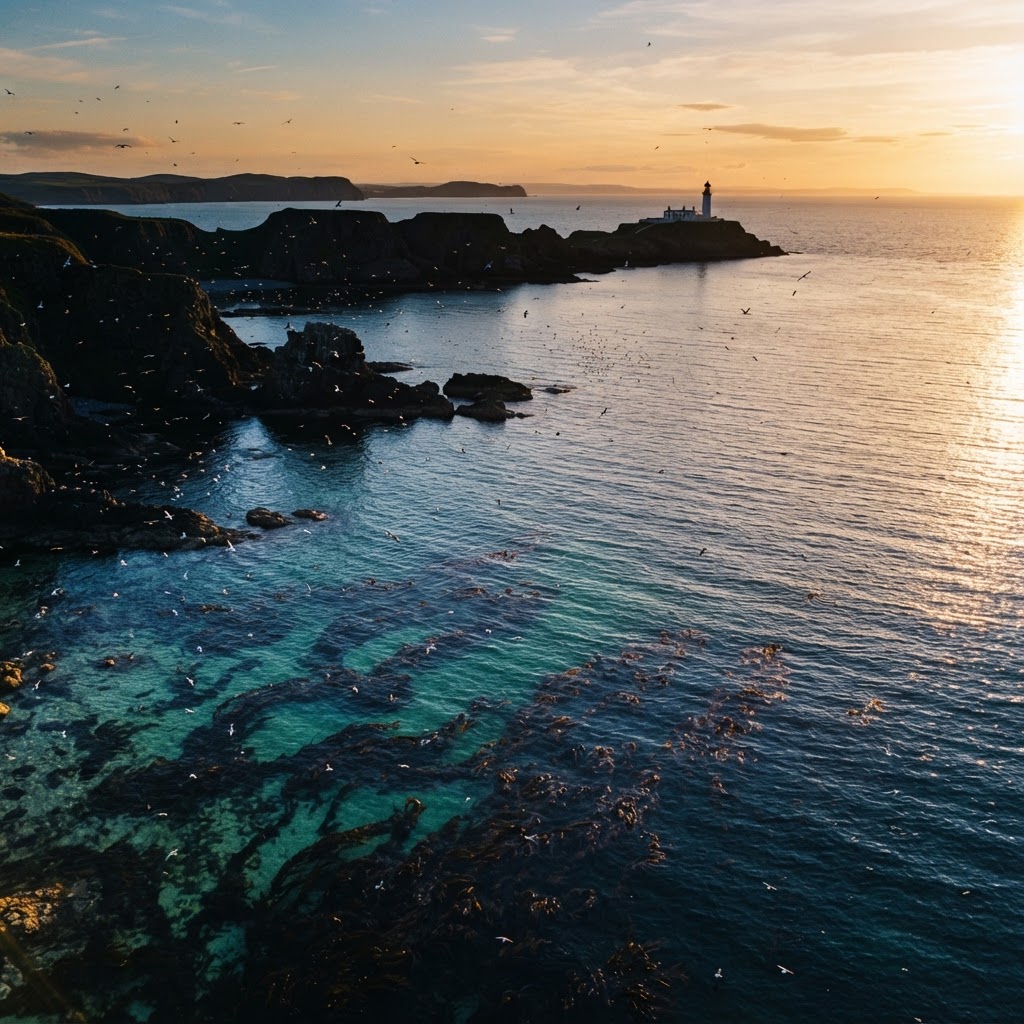
There is a forest off the Scottish coast that most people will never see. It doesn't have trees. It doesn't have soil. It grows from rocky seabeds in ribbons of gold and green, swaying with the tide. And for centuries, Scottish coastal communities understood — even without the language of marine ecology — that this forest protected them.
Kelp. The word itself carries weight in Scotland. It sounds like the kelpie, the shape-shifting water spirit of Scottish folklore that haunted lochs and rivers. But the kelp we're talking about is real, and its story is far more urgent than any legend.

THE FOLKLORE: KELP AS STORM BARRIER
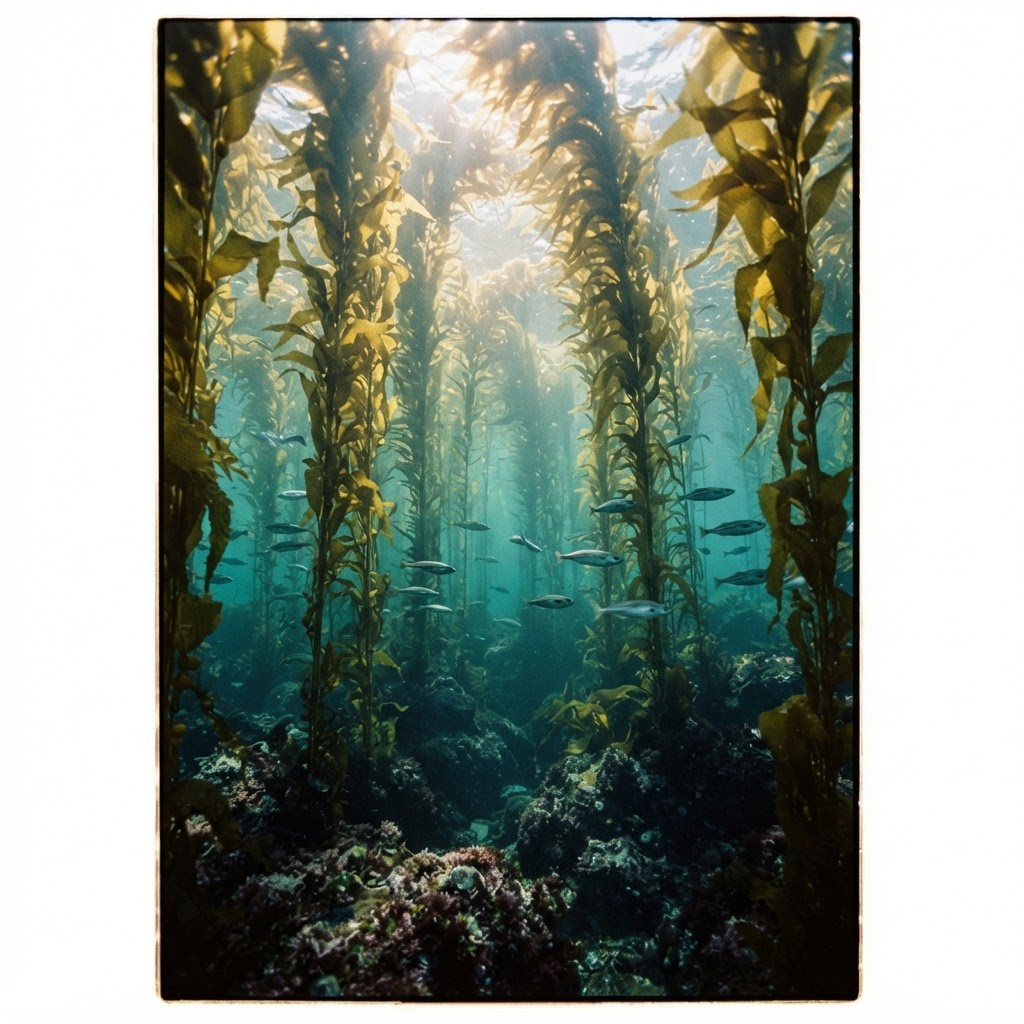
Long before marine biologists measured wave attenuation and coastal erosion, coastal communities in Scotland knew that the kelp beds offshore were a barrier. When storms rolled in from the North Sea, the dense tangles of kelp absorbed the energy of the waves before they reached the shore. Fishermen knew which coves were protected by kelp and which were exposed. Crofters knew that where the kelp grew thick, the land held firm.
In Scottish folklore, the sea is alive with spirits — the Blue Men of the Minch, the storm kelpies that haunted the straits between the mainland and the Isle of Lewis. These weren't just stories. They were a way of encoding respect for the ocean's power and the natural features that held it back. The kelp beds were part of that understanding — a living barrier, a guardian of the shore, as real as any supernatural protector the stories described.
Modern science has confirmed what the folklore always knew. Kelp forests buffer the force of turbulent ocean waves, protecting the coast against erosion, storm surges, and flooding. They are, quite literally, a barrier to storms. And when they disappear, the shore becomes exposed.
AN ECOSYSTEM VANISHING BEFORE OUR EYES
In November 2019, marine ecologist and National Geographic Explorer Brian Timmer sifted through yellowing field notes and hand-drawn maps in the archives of the University of Victoria in British Columbia. What he found redefined what scientists knew about a changing coast — and reframed the timeline of ocean warming worldwide.
The forgotten records documented bull kelp forests in the northern Salish Sea in 1972. In the early 1970s, the study area contained roughly 1,300 acres of bull kelp forest — nearly twice the size of New York City's Central Park. Today, it contains none.
"Climate change has been impacting kelp forests decades before we thought," Timmer said. The northern Salish Sea is a global hotspot for ocean warming — temperatures there have increased faster than about 90 percent of the world's oceans. A massive marine heatwave in 2015, dubbed 'The Blob,' was the final blow to remaining kelp forests that had been hanging by threads for decades.
"The scale of decline that can happen within a human lifetime — and effectively go unnoticed — is really striking," said kelp ecologist Sam Starko of Curtin University.
The Salish Sea is half a world from the Firth of Forth. But the pattern is the same. Kelp forests are vanishing from coastlines across the planet — often before anyone documents that they were there. And the consequences ripple outward: lost habitat for fish, lost food webs, lost coastal protection, lost cultural threads.

THE FIRTH OF FORTH: A COASTLINE UNDER PRESSURE
The Firth of Forth holds seabird populations of international importance. Bass Rock, just off North Berwick, is home to the world's largest Northern gannet colony. The Isle of May, Craigleith, and Fidra host puffins, razorbills, kittiwakes, and guillemots. Thousands of visitors come each year to witness the spectacle — and the area is a vital seabird migration route and foraging ground.
But the same waters that sustain this wildlife are under mounting pressure. The Scottish Seabird Centre, based in North Berwick, has been at the forefront of a fight that pits green energy against the nature it's meant to protect.
THE BERWICK BANK BATTLE
SSE Renewables proposed building one of the largest offshore wind developments in the world in the outer Firth of Forth — 307 turbines capable of generating 4.1 gigawatts of energy, sitting approximately 47.6 km off the East Lothian coastline. The Scottish Seabird Centre formally objected.
Their argument was not anti-renewables. "Climate change is one of the most pressing issues that needs addressed today and marine renewables are an essential strand of the plan to reduce our reliance on fossil fuels," said Susan Davies, Chief Executive of the Scottish Seabird Centre. "However, we are also facing a nature crisis and we must ensure that green energy is secured in ways which do not contribute further to nature loss."
The development overlaps with the Outer Firth of Forth and St Andrews Bay Complex Special Protection Area. The developer's own environmental data predicted significant annual mortality losses for black-legged kittiwakes, common guillemots, razorbills, and Atlantic puffins — species already in decline. The Seabird Centre, alongside the National Trust for Scotland, RSPB Scotland, and the Scottish Environment Link Marine Task Force, called for the development to be stopped or moved further offshore.
The compensation measures proposed by SSE — including kittiwake cliff ledges and a warden at Dunbar Castle — were described by the Seabird Centre as "tokenistic." Sandeel fishery closure, while supported as a policy in its own right, was rejected as a "smokescreen" for consenting a highly damaging development.
RESTORATION FORTH: THE WORK BEING DONE
While the battle over Berwick Bank continues, the Scottish Seabird Centre is also part of Restoration Forth — a major marine restoration partnership between charities, local community groups, and scientists. The project aims to restore seagrass meadows and European flat oyster reefs in the Firth of Forth, creating thriving habitats for marine life while improving water quality.
Restoration Forth is funded by the ScottishPower Foundation — the biggest ever grant from the foundation. It's a blueprint for how community-led marine restoration can work, and a reminder that while the kelp debate plays out in government chambers, people on the coast are already getting their hands wet.
JOHN MUIR: THE BOY FROM THE COAST
John Muir was born in Dunbar, East Lothian, in 1838 — just along the coast from North Berwick. He spent his first eleven years running wild along the shore, exploring the rocks, watching the waves, and developing the deep love of the natural world that would define his life.
Muir went on to become the father of the modern conservation movement. He championed the preservation of Yosemite Valley and Sequoia National Park. He founded the Sierra Club. His philosophy — that wild places have intrinsic value, that nature is not a resource to be extracted but a home to be protected — shaped the way the world thinks about conservation.
But it started on the East Lothian coast. The boy who ran along the Dunbar shoreline, who watched the seabirds and felt the pull of the tide, carried that coast with him to America. The John Muir Way now traces 134 miles of Scottish coastline from Dunbar to Helensburgh, passing through the very landscapes that shaped him.
Muir wrote: "When one tugs at a single thing in nature, he finds it attached to the rest of the world." The kelp forests of the Firth of Forth are attached to the seabirds, attached to the fishing communities, attached to the visitors who come to Bass Rock, attached to the climate that is warming the waters where they grow. Tug on any thread, and the whole web moves.
WHAT THIS MEANS FOR EDINBURGH HOSTS
If you host visitors in Edinburgh and the Lothians, the coastline is part of your offer. The Scottish Seabird Centre in North Berwick is a 45-minute drive from the city. Bass Rock boat trips are one of the most-booked day trips from Edinburgh. The John Muir Way passes through the region. Visitors who come for the Fringe often extend their stay to explore the coast.
But the coastline that your guests experience is shaped by what happens beneath the water. Kelp forests, seagrass meadows, and oyster reefs are the foundation of the marine ecosystem that sustains the seabirds, the fish, and the dramatic coastal scenery that draws people here. When those foundations erode, the visitor experience erodes with them.
Supporting the Scottish Seabird Centre — through membership, visits, or simply directing guests their way — is one of the most direct ways to contribute to the coastal protection that benefits everyone. The Centre isn't just a visitor attraction. It's a conservation charity on the front line of the climate and nature crises, fighting for the same coastline that makes East Lothian one of Scotland's most rewarding destinations.
THE KELP'S LESSON
Brian Timmer, the marine ecologist who uncovered the lost kelp forests of the Salish Sea, is Stó:lō from the Chawathil First Nation. He watched the kelp forests at his favourite dive sites disappear within a single year. Now he works with First Nations partners to replant them.
"Kelp is just magical in its ability to improve the ocean," said Connie Crocker of the Penelakut Tribe, who works with the Kelp Rescue Initiative. "I think restoring kelp may be that magic ingredient in helping to right some of the wrongs we've done to our seas."
In Scotland, the folklore always said the same thing. The kelp was a guardian. A barrier between the shore and the storm. The spirits of the water — the kelpies, the Blue Men — were warnings as much as legends: respect what protects you, or lose it.
The question now is whether we listen.
THE TEAM
Sharon McMenemy Khan — Creative Director & Editor. Sharon sources design inspiration, develops content ideas, and oversees editorial direction. She's a photographer, writer, and Google Maps Local Guide documenting Edinburgh and Scottish locations.
Christine Lorimer — Publishing & Community. Christine manages content scheduling, guest feedback, and the day-to-day running of the workspace.
Koda — Writer & Researcher. Koda handles research, drafting, and publishing. Written by Koda, edited by Sharon McMenemy Khan.
Comments